Wednesday, May 11, 2016

After storms, nestlings are fine

South Side


The South side had some flooding and in fact one box with eggs is on a pole that is in a little water.There is incubation going on as I found th female in the box!
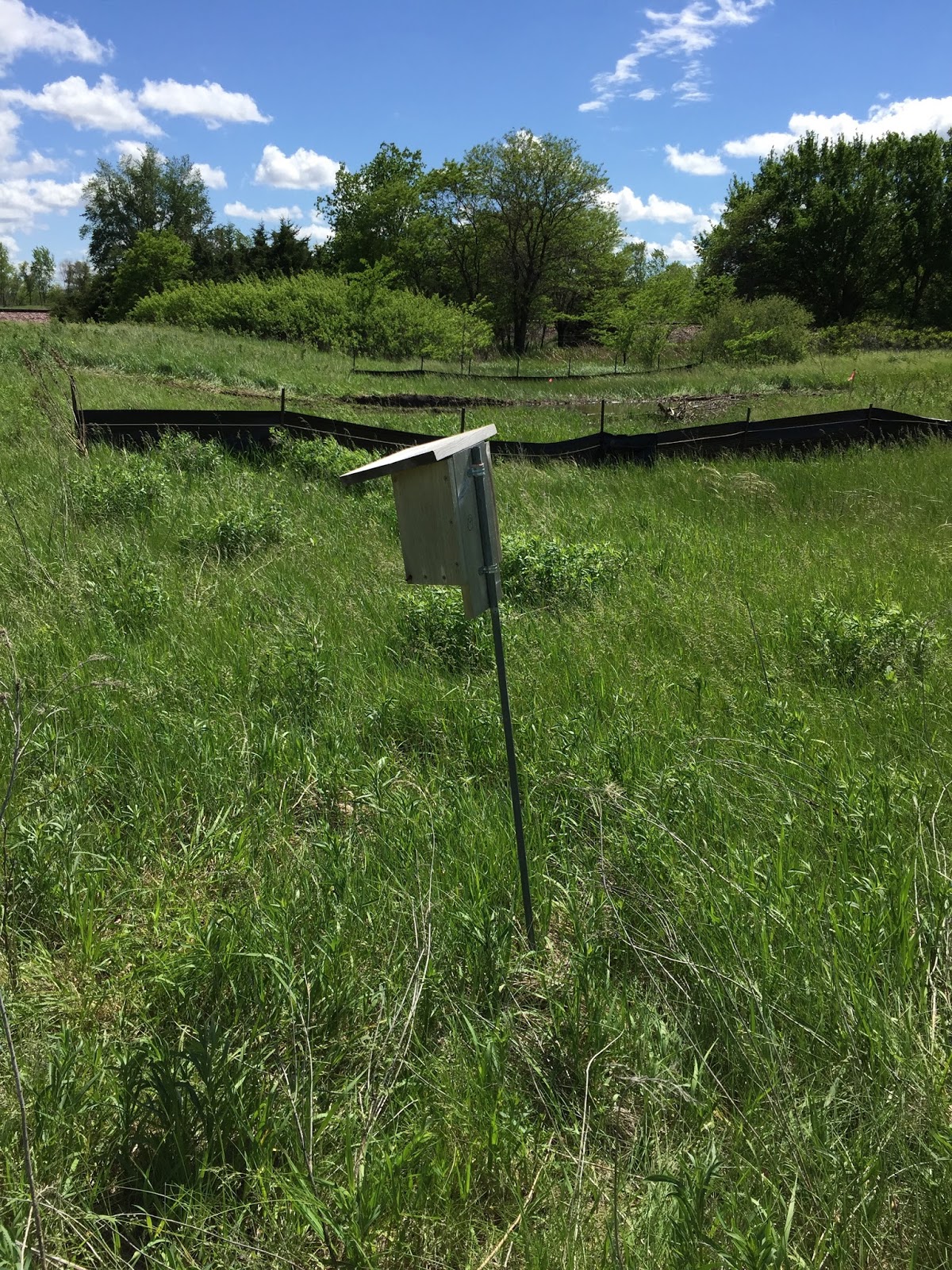

The road I need to walk on is quite flooded from all the rain.


The nestlings at the far end were staring at me and have quite a lot of body and wing feathers. This is Box 13, South side, my most advanced bluebirds.


The Box 7 family is getting feathered and eyes open but was not quite alert yet. Well, they just had lunch obviously.


  So we have four boxes with some kind of nest activity in the South but I have never seen the parents of the Box 2 eggs.

North Side


On the North side,four or five eggs just sat there for two weeks. Then over a week I did find the female on the eggs and there are now five new nestlings, just a few days old.


Also on the North side is a family with at lest three Swallow nestlings and one other box had two swallow eggs. Several boxes on the North side will have swallows, but they too will only occupy one of a pair of boxes. That is, you do not get two swallows nesting 10 feet apart in neighboring boxes. Possibly near the end of the brood another swallow pair can take over the 10 feet away box.

The swallow nestlings were quite alert. I had to hold down some lining feathers to get a picture. I first found them 8 days ago and they resembled the ones in the bluebird picture above.

Getting Wild


The South end,closed to the public, has a different feel now. Grass is not mowed off the path and I found this in the West end of the Ben V trail. Great horned owls are doing extra hunting. Their young have fledged but are still being fed mice by the parents.


Friday, May 6, 2016

Update on three nest boxes

Bluebirds 

What are bluebirds? When my son was in scouts I would walk around the camp and always find bluebirds with binoculars. The scout master could see "something blue" but claimed he had never seen a bluebird. He did not use binoculars. It is a small bird, a thrush. Like the European Robin, it is in the thrush family, but typical thrushes such as American Robin, Fieldfare, Redwing and our wood thrushes are bigger. As a thrush it eats insects, caterpillars, worms, fruit but not seeds or grain. 

The female bluebird is blue and orange as well, but paler colored. This is the mom of our Box 13 family.

Here are the male and female for comparison. Click the photo for some enlargement.


Young birds have a streaky spotty look. In the fall they often have the orange breast put have a pale color on top where the adults are blue. (Possibly these are females, as many young have blue from the start). They should be fully blue and orange before they are a year old and will nest and mate at one year age.

South Side Boxes

We have two nests with nestlings and two with four eggs. For some reason those females have not laid the fifth egg. At that point they would sit on the eggs and I would know they are incubating and nestlings are coming along.

The Box 13 family is coming along nicely and the nestlings have the feathers appearing in stick like form. The full feather starts to unfold. The bill is still partly yellow but the tip is getting like the adult bill. The feathers on the head are more like fur. There seem to be at least four. They raised their heads but lost interest in me and went to sleep.


The Box 7 nestlings are several days behind.

Swallows

Swallow nestlings on the North side are about the same stage as the Box 13 nestlings of bluebirds, but they made calling sounds as I opened the door, expecting mom and dad with food. Then they too lost interest. They will be screaming for food for most of the day soon enough and not sleeping so much. The tip of the bill again has lost its original yellow and will be a longish swallow bill with a wide gape.
 

Tuesday, May 3, 2016

Bluebird Timetable

Since I don't make money off this, I've just borrowed a timetable from Sialis.org. Some technical feather terms but it gives you a general idea.

Egg Laying 5-7 days, One egg each

Incubation 12-14 days

Hatching, followed by

  • Day 1: dingy gray down, eyes closed. The babies heads look huge. Their wings are nubs, and legs are weak and spindly. Uncoordinated, raising head weakly and unsteadily, faint vocalizations.
  • Day 2: contour feathers start to develop. Soft gray down is now along the edges of wings, the head and spine. The skin beneath looks blue-black as feathers begin to develop beneath it.
  • Day 3: femoral tract feathers begin emerging.
  • Day 4: wings are dark.
  • Day 5: feathers appear in crural region. Eyes open day 5-6. While sleeping, head held limply in front or curled to side.
  • Day 7-8: able to maintain body temperature.
  • Day 8: secondary wing-coverts break out of sheaths.
  • Day 9: capital feathers, secondaries and retrices are out of sheaths; birds use bill to work all major feather tracts. Nestlings may show fear if handled, can crawl. Yawning first observed. May lay head on scapulars while sleeping.
  • Day 10-11: most capital-tract feathers emerge.
  • Day 11: Feather sheaths start to disintegrate (leaving a white dust behind) and wing feathers begin to emerge. Nestcams indicate nestlings start to stand up at this age. Nestlings start to preen, pulling at the sheaths of emerging feathers.They may flap wings, stretch and hop a little to strengthen muscles.
  • Day 12: almost completely feathered. except for mid-ventral region. Incomplete bill-wiping movements and head scratching first observed.
  • Day 13: Mid-ventral region is feathered. sleep with head on scapulars. Can tell sex by bright blue color of primaries and retrices, and white on retrices. Sleep in typical adult manner.
  • Day 14: no unfeathered areas visible. Wings are longer. Capable of weak, short-distance flight. Bird can right itself and make short shuffling movements backwards and forwards.
  • Day 15: completely feathered. Nestlings huddle together, preen, exercise, stand on edge of nest and look out of nest cavity.
  • Day 16: able to hop well by day 16. During final days in nest, nestlings flap wings vigorously.
Fledging Day 17-18

Survival

Sparrows

In our neighborhood I found a bluebird box with sparrows in it. About a week ago there were three nestlings in it. Yesterday there was one barely alive and today nothing. The parents remove the nestlings that do not survive. Sparrows can feed on seeds but they feed their nestlings insects and caterpillars. Last week was a cool week. They had to survive themselves to try nesting again.


Sparrow's nests are often round shaped with a a roof over and just the opening on the side. I believe that was the same box. I checked them all in that section and none had nestlings. One box actually had five bluebird eggs but they mysteriously disappeared, all but one, over one day. Yes, there are other birds that eat eggs. These boxes are cleaned out once a year by someone. They are in no way ideal for bluebirds, being so close to a bike path. But some use may come of them. at least house sparrow nests.

Bluebirds

Our South side birds are doing well. It looked like whatever work on the trail (with bulldozers) had gone on was wrapping up.

 In what I call Box 13 are five nestlings. The mom never left the nest on previous visits but on a warm day like today the nestlings were alone, content from the morning feedings and sleeping. In fact the dad came by with food and nobody responded so he ate it himself. The dad is in some brush not far from the nest:


Here is the mom on the nest when she still had eggs.  


And the resting nestlings. The Box 13 family.  I think we are at day 4 or 5.

There will more pictures of the Box 7 family soon enough, There was a similar clutch inside. Here is just the box. I have never seen the female but she kept the eggs warm through the cold spell. I have a picture of the empty grass nest from it in the previous blog, look back.


The birds seem to like the compact boxes. Some bigger boxes are available and some brand new. One more box (2) had five eggs in the South end. So we are expecting up to 15 nestlings on the South side (now locked at the bridge)

Swallows

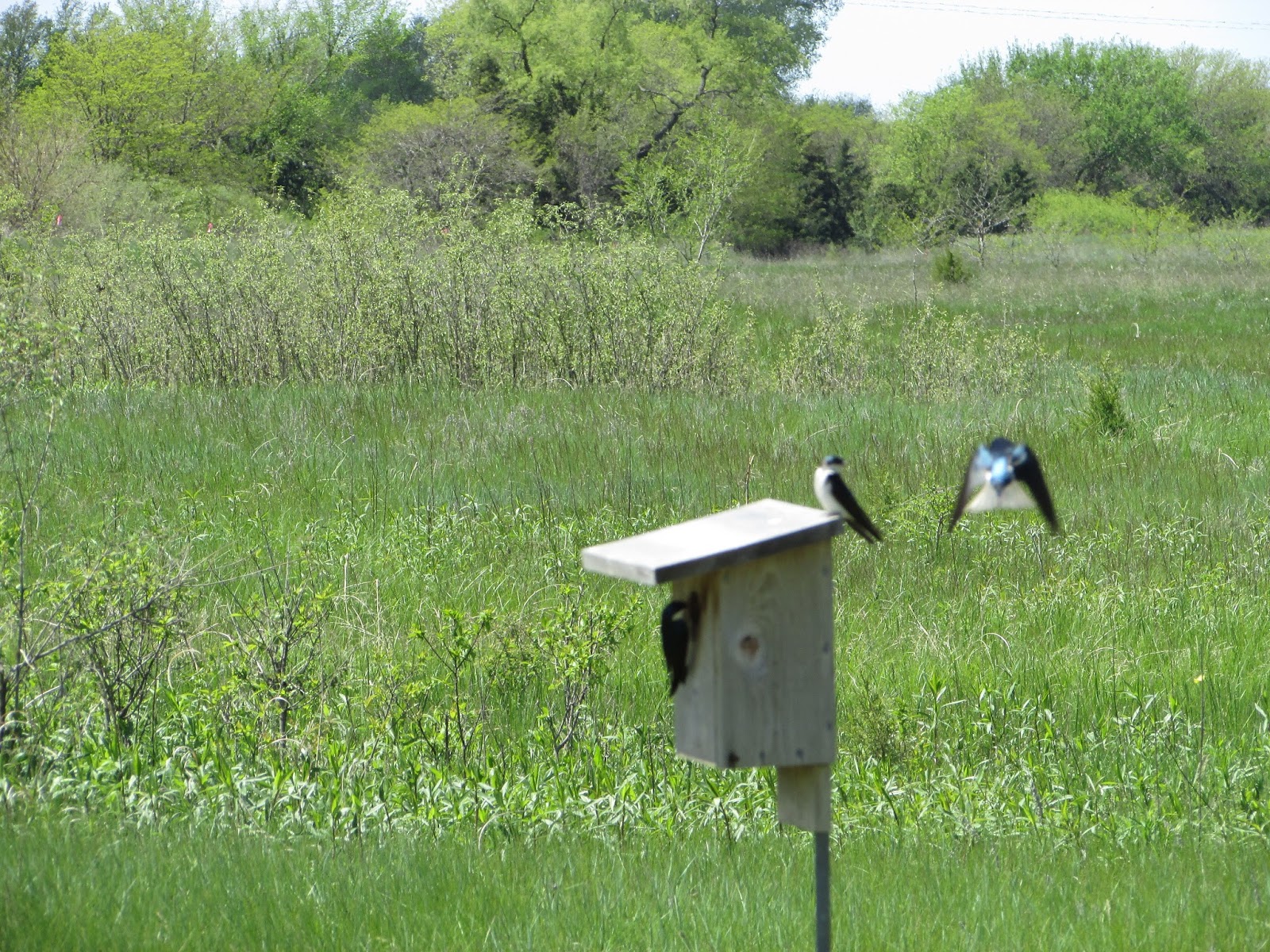
Swallows were fighting over Box 1 on the South side and Box 11 on the North side. Up to three males circle the box, land, go inside and so and. This is just to show to a female that "I have a nest box". I believe he does not make any nests. 


The surprise of the week was a swallow's nest with nestlings when all the other swallow nests do not even have eggs in them. Among the feathers (sign of swallow nest) were some sleeping nestlings. 


The swallows must have found enough insects to feed the nestlings and themsleves. In bad weather, bluebirds can find berries. I think these swallows may be able to eat some vegetable matter as well. Of all the swallows, these are the most song bird like and have feet to land and walk on unlike useless barn swallow feet. In the swallow category, I found a dead male in a box. The birds roost in empty boxes all year, This one was probably old or sick. I have to remove some dead things once in a while. If eggs start to rot they have to be taken out.

All in all, life goes on. People running bluebird nest box lines have always been impressed that they seem to plan well and rarely abandon eggs and never nestlings. It is all  a matter of survival and doing your job. People that study bluebirds say they live one or two years and very few nest and live to the third year. They make the most of it.

Tuesday, April 26, 2016

How to contact blogger

I got some feedback from local birders and one wished to comment. I've disabled comments on the blog because it just fills up with ads for fake Rollex watches and other spam.

Contact me directly and I will respond via
esaterojarvi@yahoo.com

Esa

Monday, April 25, 2016

Swallows settling in and claiming many boxes

Where Do Bluebirds Nest?

We have set up some 30 boxes with the intent of providing bluebirds a nest box. They will  not nest in them all, as they are a bit fussy. So if a pair settles into a box, another bluebird pair will want to be about 100 yards away. If the boxes are not suitable, they will nest in any hole, but not in buildings usually. A woodpecker hole is fine, up to 50 feet in a tree. The bluebirds have to compete for those holes. Starlings like to use them as well, but starlings will not nest in a box that is only 4-6 feet from the ground.

I think there are some four pairs at this time using boxes or looking for nest boxes in the South end, where there are 14 boxes. I found a well made grass nest in the middle about a week ago. It still had no eggs, and it may be because there were some bullodozers doing land maintenance there sometime the past week. The box is indicated by the arrow. Click the picture for a bigger view.


The nest inside is fine. I inspected it and put it back. There are plenty of empty boxes but I am not sure if others are much better as far as the construction disturbance goes. There are sticks and markers all along the Ben V trail.


Bluebirds nest in trails people have set up. Some have a small property and may have just 2-3 boxes. By moving them aroung year to year, they can have success in all three boxes. In Lancaster county, 459 nest boxes were used and monitored in 2013. I think I found the line for our boxes. It looks like there were 7 nests that season, which includes the same birds nesting more than once in the same house. One champion ”bluebirder” monitored 230 boxes and had success in at least a fourth of the boxes. Over 500 birds fledged from the 230 boxes in that year. The list includes other nearby states that somehow are recorded in our NE records.

Not So Fussy Swallows

The tree swallows around have started to build nests. They have not laid eggs yet, but do sit on the box and go inside. This probably means that any remaining bluebirds will not look at those boxes claimed by the swallows. The boxes are in pairs, so the swallows prefer to pick one box of a pair at this time. Of 17 boxes on the North side, at least seven are now claimed by swallows.

On the South side, one pair of swallows is guarding two boxes with a nice bush in between to land on. Another pair of swallows has claimed a nest box next to one that has bluebird eggs and nest. 


Thursday, April 21, 2016

Three Nests With Eggs!

First, I went to the Bluebird conference in Unadilla. These folks will set you up with bluebird nest boxes if you have semirural property or even on the edge of town facing farm fields. The website has instructions to order. http://www.bbne.org/

Now, the excitement is that we have three nests. I took this picture of a partial clutch, which was not being guarded by the parents. The female will begin to incubate with five eggs, usually.


This nest is on the North side near the Nature Center. if you see bluebirds on the way to the goose pond from the Nature Center, they may be the parents. They sit up on the fence usually.

On the South side there are two nests with eggs. You won't be able to see this activity because the bridge is now closed for construction. Down there, I found three nests, but one was just grass, and the swalows were sitting on those two boxes. No sign of bluebirds. They may have given up there.

Near the center of the Ben V trail, there are two occupied nests. One has five blue bluebird eggs and the other has a tree swallow nests with no eggs:


The one up front is the swallow nests and the bluebirds picked a similar box but lower down in elevation, in back, There was a flurry of bluebird and swallow activity on these, at least six swallows.

At the very far end the male is still guarding an empty box, my Box 14, while the female is on eggs at Box 13. She has a full clutch, as she refused to leave the nest so I could see how many eggs there are. You can see her tail sticking out to the left.


While it's good to keep track of nests and nestlings and do what we can to keep predators out, I won't be opening all the boxes once there is nesting going on. Some of them are a bit shaky and the door and nail are hard to work loose with birds inside. So we will take pictures from outside and also one or two of nestlings inside, but with minimal intrusion. Estimates of successful nests can be made without counting every egg and nestling.